
Alice Fookes Calls for Action after International Ministerial Conference on Preventing Sexual Violence in Conflict Initiative (PSVI)

Alice Fookes Calls for Action to Prevent Sexual Violence in Conflict
At the recent PSVI Ministerial Conference, Dr. Mukwege, Medical Director at Panzi Hospital and inspirational 2018 Nobel Peace Prize Laureate, said:
“The PSVI Conference is organised so that all of us attending in London can listen to survivors’ voices. This is not the first conference where survivors have spoken up demanding justice, but I hope it will be one of the last – we need to attend as we count down to end wartime sexual violence.
“We are all here today because of survivors. All of them attending this conference represent thousands of others awaiting care, justice and reparations. Very few survivors have received the holistic care – including justice – that they deserve. As the survivors are sharing their recommendations, requests, and opinions, I ask everyone not only to listen to them but also pledge a commitment to act and support their demands.”
PSVI Conference, November 2022
I was fortunate enough to attend this event on behalf of Widows for Peace (WPD) together with Margaret Owen OBE, our WPD President, who has written her own piece on the WPD website and who said:
“Alas, however, key voices remained unheard. Omitted from the programme, in spite of urgent pleas from relevant NGOs, were widows of all ages and half-widows (wives of the missing or forcibly disappeared). The voices of this largest category of women who are the most vulnerable to rape and sexual slavery, long after formal peace accords are signed, were not heard nor their plight and needs mentioned”
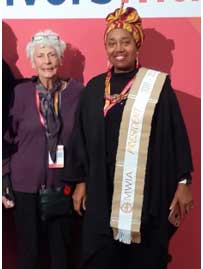
It was also very special that Dr Eleanor Nwadinobi (founder of WiDo Africa – WPD partner in Nigeria) could also join Margaret and myself at this important ministerial gathering.
I was delighted that the NAWO’s Young Women’s Alliance chose to concentrate on ‘invisible’ widows and widowhood as one of their three #16DaysofActivism keynote events. It was humbling and deeply reassuring to be certain that the next generation have no intention of allowing the appalling treatment of women and girls – often widows and some still girls – to go unseen or unnoticed by the wider world.
The UK’s Foreign Secretary, James Cleverly, hosted the international Preventing Sexual Violence in Conflict Initiative (PSVI) Conference in London.

A political declaration on preventing conflict-related sexual violence (CRSV) was agreed.
Although many fine words were spoken my personal views (and they are my own views) are that there was a great deal not said, not done and not delivered.
Two of my key observations at the PSVI conference:
I have chosen to focus first on two very different observations because so often all we get are bland statements following events of this nature.
Second, I offer six conflict-widow focussed recommendations – all of which I have used to demonstrate on how conflict widows should be included, supported and made visible.
Having advocated with Widows for Peace and argued strongly and urgently for the inclusion of conflict widows throughout the conference preparation period, I was immensely disheartened to find that conflict widows and half-widows (the wives of the disappeared or forcibly disappeared) and widowhood were deemed by the FCDO not be relevant to this event.
I was told they could not include all affected groups. I understand that. But how can conflict or war of any kind, the great widow maker, be deemed irrelevant to such a large global group – conflict widows of all ages?
Sexual violence is what all too often happens to widows in and after war. The men are killed and widows, women and girls are raped and abused. I argue that an exception for this group should have been made: the naming of widows at this conference. Instead they were marginalised and thus made ‘invisible’.

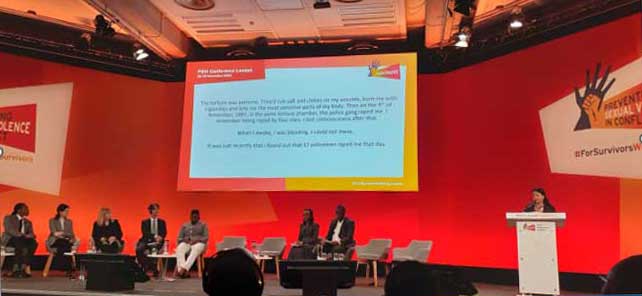
The Foreign, Commonwealth and Development Office (FCDO) faced harsh criticism after Ivica Dačić was invited to speak at the conference.
Ivica Dačić is a former ally of nationalist president of Serbia – Slobodan Milošević. Under Milošević’s regime, sexual violence was used as a weapon of war and instrument of systematic “ethnic cleansing”.
On the same panel was Kosovo Deputy Prime Minister and Minister of Foreign Affairs, Donika Gervalla-Schwarz, who was warmly applauded by the audience after she strongly objected to the presence of the Minister of Foreign Affairs of Serbia, Ivica Dacic.
Donika Gervalla said:
“I am shocked by the presence on the panel of Ivica Dacic, one of the perpetrators of the crime, one of the main architects of the genocide in the Western Balkans, in Bosnia and Kosovo, and having this architect advising on the presence of the victims and survivors should make us think about the meaning of these conferences.”
I was at that extraordinary meeting and reiterate that NGOs, civil society, and the FCDO need to be super-careful in how these conferences are planned and delivered.
The FCDO outcome Policy Paper: Preventing Sexual Violence in Conflict Initiative (PSVI) conference 2022: a political declaration on conflict-related sexual violence is now available to view.
My suggested critical conflict widow action points (based on Amnesty International general recommendations) – the call for more informed gender aware training for government funders, donors and policy writers has never been stronger.
- Consult with conflict widow survivors, advocates and widows human rights defenders and ensure their participation in decision making that affects their interests;
- Support and enable widow human rights defenders, including survivors and associations to safely speak out;
- Address patriarchal social norms and stereotypes that fuel gender-based violence and sexual violence towards conflict widows of all ages;
- Provide conflict widow survivors of sexual violence with accessible medical care and support services including access to safe, legal abortion services and maternal health support;
- Create programmes of assistance and reparation for survivors of sexual and gender based-violence, including school and public educational programmes to eradicate stigma and discrimination to break cycles and cultures of victimisation and disempowerment of conflict widows, women and girls;
- Legislate against sexual and gender-based violence in conflict according to the highest international human rights standards.
Finally, without proper widow-aware data gathering, widows and other marginalised women are effectively made invisible to analysts, statisticians, policy makers and legislators and must include: marital status, age, numbers and ages of widows and their children. Assessment of need is vital as is the actual roles of widows and half-widows in building survivorship and resilience.
Conventional survey methods are not always suitable and also lack of capacity especially in conflict or post-conflict settings where widows may be homeless, undocumented, possibly illiterate and moving between refugee and IDP camps. It is important to look at alternative data collection methods – and there is a vital role here for NGOs to fill this knowledge gap.
There were positives to come out the meeting such as the work to bring ownership to survivors to use their voices on an international platform to demand their rights, their justice and that their voices be heard. To me this was the beginning of the journey and much still needs to be done to expand this invaluable contribution for future events.
Alice Fookes, WPD Trustee & Advocate, December 2022
Also read: Margaret Owen OBE: PSVI – ‘The Voices of Widows and Half-Widows Still Needed as Ever’